
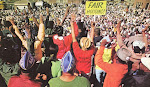
 The mythic image of the "melting pot" has been a powerful trope throughout American history to describe how such a diverse country becomes one nation. Yet, over time, this narrative has come under fire from activists and academics. During the 60s, political activists in the civil rights movement saw the melting pot as another form of forced assimilation and cultural/historical erasure. Academic historians also have seriously challenged the idea that America has ever successfully "melted" its various constituent parts into some unified American character. Some have offered, instead, the metaphor of the "tossed salad," which emphasizes both the distinctness of individual cultures/histories, while also acknowledging that we share some sort of common experience/destiny as USians.
This is not a purely academic question. The narrative we use reveals quite a bit about how we think of ourselves and how we deal with diversity.
 Recently, I came across an interesting article - "American Melting Pot vs Indian Cultural Mosaic" - which speaks to these issues over at New American Media. The essay is written by Punit Arora and originally appeared in India Currents.
The article defines "cultural mosaic" this way:
Cultural Mosaic is a term that was first coined by John Murray Gibbon in Canadian Mosaic. Gibbons disapproved of the American concept of the melting pot because he felt it asked immigrants to cut-off ties with their roots and culture and adopt completely alien practices. In contrast, he felt that Canada should promote a mosaic approach in which each wave of immigrants could contribute something new to the society.
Arora further argues that India offers more support for the mosaic approach:

While the United States necessitates that we each adapt to dominant cultural norms, India, more than any other country in the world, emphasizes the adoption and promotion of the “cultural mosaic” approach. By celebrating differences and by according legitimacy to the values held by all communities, India makes it possible to negotiate and develop a synthesis.
How do you think about diversity in America? Do these narratives matter? If so, how? To what extent do immigrants have a responsibility to assimilate ("melt") into mainstream American culture and to what extent should they maintain their cultural and historical ways?

