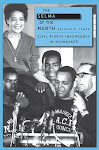

Looks interesting:
Here is an article on the film from The Root.
Seen any good films lately?
Showing posts with label art. Show all posts
Showing posts with label art. Show all posts
Friday, February 27, 2009


Monday, December 15, 2008
Writing Art
The Sheldon Museum of Art, which sits on UNL's campus, recently acquired 7 or 8 new pieces by well-known African American artists like Aaron Douglas, Charles White, Lois Mailou Jones and others. The director of the museum asked me to write two short entries for a catalog they are doing on the new work. Here are the works and the words I came up with:
• Charles White, "Frederick Douglass Lives Again (The Ghost of Frederick Douglass)"; pen & ink (1949):

• Aaron Douglas, "Emperor Jones" series; woodcut print on Japanese paper (1929)
"Flight"

"Surrender"

"Defiance"

"Bravado"

• Charles White, "Frederick Douglass Lives Again (The Ghost of Frederick Douglass)"; pen & ink (1949):

Charles White was born in 1918 on the south side of Chicago, at the epicenter of the “great migration.” White’s maternal grandfather was a slave in Mississippi, his father a rail, steel and construction worker and his mother a domestic. Throughout his career, White’s art consistently emphasized the contributions of working-class African Americans and heroicized their struggles for freedom and equality.
From a young age, White displayed artistic talent and a voracious reading appetite. He was particularly influenced by Alain Locke’s 1925 anthology, The New Negro, which encouraged a younger generation of self-confident and politically aware African American artists to redefine blackness and push for racial change. The onslaught of the Great Depression furthered White’s commitment to social realism and politically relevant art.
During the 1930s, White became interested in the controversial murals of Diego Rivera. "I found a strong affinity in terms of my goals as an artist and what [Mexican muralists like Rivera] represented," White later recalled. Like many artists and writers of his generation, White worked for the Works Progress Administration and, in 1940, was commissioned to create a large mural celebrating the black press. The following year, White toured the American South, an experience he credited with pushing “racial forms and subjects” to the “foreground” in his work. After a series of health challenges and a divorce from sculptor, Elizabeth Catlett, White settled in New York City, where he participated in the city’s thriving black intellectual community, showed his work with other socially conscious artists and published in progressive and left periodicals.
In 1949, White completed “Frederick Douglass Lives Again (the Ghost of Frederick Douglass),” one of a number of powerfully expressive pen and ink drawings from this period that depict black experience under Jim Crow and the burgeoning post-war civil rights movement. The work emphasizes the inter-generational nature of the struggle for racial justice and testifies to both the strength and suffering of black Americans, what one critic called “the throbbing emotion of Negro spirituals.”
• Aaron Douglas, "Emperor Jones" series; woodcut print on Japanese paper (1929)
"Flight"

"Surrender"

"Defiance"

"Bravado"

Aaron Douglas (1899-1979) is the best-known visual artist of the Harlem Renaissance. Born in Topeka, Kansas, in 1899, Douglas was nurtured by a strong, progressive black community and influenced early by the work of Henry Ossawa Tanner. Like thousands of other African Americans, Douglas migrated North, graduating from the University of Nebraska-Lincoln in 1922 and then moving to Harlem in 1924, where he studied under German-born artist, Winold Reiss. Douglas’s work included paintings, illustrations and murals and combined elements of West African and Egyptian art, impressionism, cubism, art deco, and Mexican muralism into a unique visual style rooted in race pride. “I refuse to compromise,” he explained, “and see blacks as anything less than a proud majestic people.”
While Douglas is most famous for a series of large murals he completed during the depression-era, he first gained notoriety as an illustrator during the 1920s. Throughout the renaissance period, Douglas designed covers and illustrations for The Crisis (NAACP) and Opportunity (Urban League), as well as for literary works by James Weldon Johnson, Langston Hughes and Claude McKay. In 1925, Alain Locke hired Douglas to illustrate his groundbreaking anthology, The New Negro. The following year, Douglass, Hughes, Zora Neale Hurston, Wallace Thurman and Bruce Nugent published FIRE!!, a controversial magazine that featured poems, stories and illustrations on jazz, blues, poverty, religion, prostitution and homosexuality. Embracing the ideology of the “New Negro,” Douglas strove to create an African American aesthetic that was both political and spiritual. “Let's bare our arms and plunge them deep through laughter, through pain, through sorrow, through hope, through disappointment, into the very depths of the souls of our people and drag forth material crude, rough, neglected,” he wrote. “Then let's sing it, dance it, write it, paint it. Let's do the impossible. Let's create something transcendentally material, mystically objective. Earthy. Spiritually earthy. Dynamic."
In 1926, Theater Arts Monthly commissioned Douglas to illustrate scenes from Eugene O’Neill’s racially charged play, “Emperor Jones.” The play helped launch the career of Paul Robeson and is credited as the first Broadway show to feature a racially integrated cast and black lead. The hard, flat contrasts of these energetic, monochromatic woodcuts, the repetitive use of geometric forms and the assertive, assured tone are typical of Douglas’s print work.
Friday, November 21, 2008
Trashy Art...
 This is one of Tim Nobel and Sue Webster's pieces of art made from everyday garbage. To see other examples, click here.
Wednesday, October 01, 2008
Monday, September 15, 2008
Exuberant Riffs on a Land Run Amok
 I was sorry to hear this weekend that the gifted writer, David Foster Wallace, has killed himself. Here is an obituary and a good appreciation from the New York Times. Here is another tribute from Salon.
Wednesday, July 23, 2008
Paul Fusco: RFK's Funeral Train
 After Robert Kennedy's assassination, his body crossed the country by train. All along the way, people flocked to the tracks to pay their last respects to the fallen leader. They came in throngs, they came in groups of one, two and seven. They were white and black and brown. They were poor and middle class. They were Democrats and Republicans.
 Photographer Paul Fusco was there and captured some of those who came to bid good-night to RFK. The M + B Gallery is currently showing some of Fusco's images. Here is how they introduce the exhibit:
M+B is pleased to announce the exhibition PAUL FUSCO: RFK FUNERAL TRAIN. The opening will coincide with the 40th anniversary of the assassination of Robert F. Kennedy. On a Saturday afternoon on June 5, 1968, Magnum photographer Paul Fusco accompanied the body of Robert F. Kennedy as it made its way from New York City to its final resting place in Arlington Cemetery, near Washington, D.C. Transported by train, the coffin was placed in the last of twenty-two cars and elevated so that it was visible through the large observation windows. However, it was what lay outside the train that interested Fusco most: the track-side mourners who--silent, curious and patient--waited to pay their respects.
"They were mostly ordinary Americans: young parents, retirees, nuns, men in suits, teenagers in shorts. Some waved happily. Others wailed in grief. Some stood quietly, hand to heart. Others snapped pictures. Some looked plainly curious. Others hoisted placards of farewell. Some brought flowers, many only themselves. Boy Scouts waved the Stars and Stripes. A woman knelt, her hands touching in prayer." (Margarett Loke, New York Times)
A uniquely profound record, RFK FUNERAL TRAIN is an oblique chronicle of the tragedy and trauma of Robert F. Kennedy's assassination. In tribute to RFK's raw empathy and his determination to make lives better across the social spectrum, hundreds of thousands of people stood patiently in the searing heat to pay their respects. It was one of those rare instance during the Civil Rights era that showed a nation coming together, when both black and white shared a respect for a leader whom they believed could have healed the country's wounds.
In vivid color, Fusco's study provides a unique exploration of a nation coming to terms with the loss of a president who never was. It presents a snapshot of a broad range of American citizens and conveys the depth of civic feeling engendered by the tragedy. With their strange blend of valediction and voyeurism, these pictures capture a decisive moment in American history, pictures in which the subject is forcibly absent. In an equally profound way, RFK FUNERAL TRAIN offers a salient and instructive contrast to the diminishing levels of affection that the public holds towards the political classes of today.
Paul Fusco was born in Leominster, Massachusetts in 1930. He received his B.F.A. in photojournalism from Ohio University and went directly to work for Look magazine as a staff photographer and traveled extensively in South East Asia, Mexico, India, Europe and Russia. In 1974 he joined Magnum Photos. His work has appeared in many domestic and international publications such as Life, Time, Newsweek, The Sunday Times and Paris Match. He has exhibited at the Metropolitan Museum of Art, New York; San Francisco Museum of Modern Art; Newseum, New York and the Corcoran Gallery, Washington, D.C. RFK Funeral Train was published by Umbrage Editions in 2001, with an introduction by Norman Mailer. Most recently, the Metropolitan Museum of Art in New York acquired six of his photographs from this series.
Here are a few for your consideration:


Any thoughts...?
Saturday, July 19, 2008
Post Secrets
PostSecret is an ongoing community mail art project in which people mail their secrets anonymously on one side of a homemade postcard. The simple concept of the project, which began in 2004, was that completely anonymous people decorate a postcard and portray a secret that they had never previously revealed. No restrictions were (or are) made on the content of the secret; only that it must be completely truthful and must never have been spoken before. Entries range from admissions of sexual misconduct and criminal activity to confessions of secret desires, embarrassing habits, hopes and dreams. So far, they project has gathered and displayed more than 2,500 postsecrets...
Here are some examples:


What do you think? Got a secret you need to let out...?
Here are some examples:


What do you think? Got a secret you need to let out...?
Saturday, June 28, 2008
David Byrne Radio
 I like David Byrne, former lead singer and creative madman behind the genius of the Talking Heads. Byrne has a great website you should spend some time with. In particular, check out his free online radio station, which plays all kinds of interesting, rhythmic, genre-blending, globe-trotting music...
OK, while I am at it, watch this trippy, hilarious interview with David Byrne, by David Byrne, from the "Stop Making Sense" days:
And, here is the classic opening of Stop Making Sense, one of the great live music films of all time:
Sunday, June 08, 2008
Arthur Ganson: Sculpture That's Truly Moving
Sculptor and engineer Arthur Ganson talks about his work -- kinetic art that explores deep philosophical ideas and is gee-whiz fun to look at...
(thanks, as always, to TED)
(thanks, as always, to TED)
Saturday, May 24, 2008
Saturday, May 17, 2008
Wednesday, May 14, 2008
Robert Rauschenberg Dies at 82

Famed artist, Robert Rauschenberg, has died. He was 82. Rauschenberg was one of the most prolific and controversial major American artists of the last half of the 20th century. He pushed the boundaries of what art is and thereby infuriated a lot of folks. People tend to love or hate his work.
Here is the NYTimes obituary. Here is an interesting lengthy review of a book about Rauschenberg and the "neo-avant garde." Here are several pieces of his work...


Here he is talking about one of his controversial pieces:
Wednesday, April 30, 2008
77 Optical Illusions

When I was in elementary school, I got fascinated with optical illusions and did what seemed at the time like a huge report on visual trickery. Ever since, I've always had a soft spot for such things. Here is a website with 77 different optical illusions for your enjoyment...
Monday, April 14, 2008
Mexican Superheroes!
Over at Mother Jones, they recently ran a photo-essay by photographer Dulce Pinzon, titled, "Mexican Superheroes," and with a secondary headline that read, "It's a Bird...It's a Plane...It's a Mexican Immigrant". MJ described the 4-photo spread this way: "Pinzon posed undocumented Mexican immigrants in superhero costumes and captured their feats of derring-do in New York City." I thought it was worth reposting...
Here are the photos and the text that appeared with each one:
Photo #1: "It's Clobberin' Time"
 Luis Hernandez (The Thing) works in demolition and sends $200 a week home to Veracruz.
Photo: #2: "Super Fry"
 Oscar Gonzalez (Human Torch) is a cook. Originally from Oaxaca, he sends home $350 a week.
Photo #3: "Spidey Cents"
 Window washer Bernabe Mendez (Spider-Man) sends $500 a month home to Guerrero
Photo #4: "Kitty Sitter"
 Minerva Valencia (Catwoman) works as a nanny. She sends $400 a week home to Puebla
Any thoughts or comments about this photo-essay, or its meaning?
Here are the photos and the text that appeared with each one:
Photo #1: "It's Clobberin' Time"
 Luis Hernandez (The Thing) works in demolition and sends $200 a week home to Veracruz.
Photo: #2: "Super Fry"
 Oscar Gonzalez (Human Torch) is a cook. Originally from Oaxaca, he sends home $350 a week.
Photo #3: "Spidey Cents"
 Window washer Bernabe Mendez (Spider-Man) sends $500 a month home to Guerrero
Photo #4: "Kitty Sitter"
 Minerva Valencia (Catwoman) works as a nanny. She sends $400 a week home to Puebla
Any thoughts or comments about this photo-essay, or its meaning?
Friday, January 18, 2008
Learning to Love You More

A few years back, I went to see "Me and You and Everyone We Know," the sweet and touching indy film written, directed and starring artist Miranda July. I really enjoyed the way the characters in the film were reaching for human connections and the overall strange etherealness that pervades July's narrative style.
... intrigued by the fact that she was an artist who became a filmmaker, I visited her website, which then led me to an ongoing web-based project that she and fellow-artist Harrell Fletcher are doing called, Learning to Love You More. Here's how they explain themselves:
Learning to Love You More is both a web site and series of non-web presentations comprised of work made by the general public in response to assignments given by artists Miranda July and Harrell Fletcher. Yuri Ono designs and manages the web site.
Participants accept an assignment, complete it by following the simple but specific instructions, send in the required report (photograph, text, video, etc), and see their work posted on-line. Like a recipe, meditation practice, or familiar song, the prescriptive nature of these assignments is intended to guide people towards their own experience.
Since Learning To Love You More is also an ever-changing series of exhibitions, screenings and radio broadcasts presented all over the world, participant's documentation is also their submission for possible inclusion in one of these presentations. Past presentations have taken place at venues that include The Whitney Museum in NYC, Rhodes College in Memphis, TN, Aurora Picture Show in Houston, TX, The Seattle Art Museum in Seattle, WA, the Wattis Institute in San Francisco CA, among others.
Since LTLYM inception in 2002 over 5000 people have participated in the project.
Sounds cool, doesn't it?
Here are a few of the many "assignments":
• Make an educational public plaque.
• Draw the news.
• Give advice to yourself in the past.
• Make an exhibition of the art in your parent's house.
• Take a picture of your parents kissing.
• Recreate a poster you had as a teenager.
• Curate an artist's retrospective in a public place.
• Grow a garden in an unexpected spot.
• Recreate the moment after a crime.
• Take a picture of strangers holding hands.
The site has a way of simultaneously uplifting and unsettling... Check it out (and do an assignment or two while you're at it):
Learning to Love You More
Thursday, December 06, 2007

Subscribe to:
Posts (Atom)